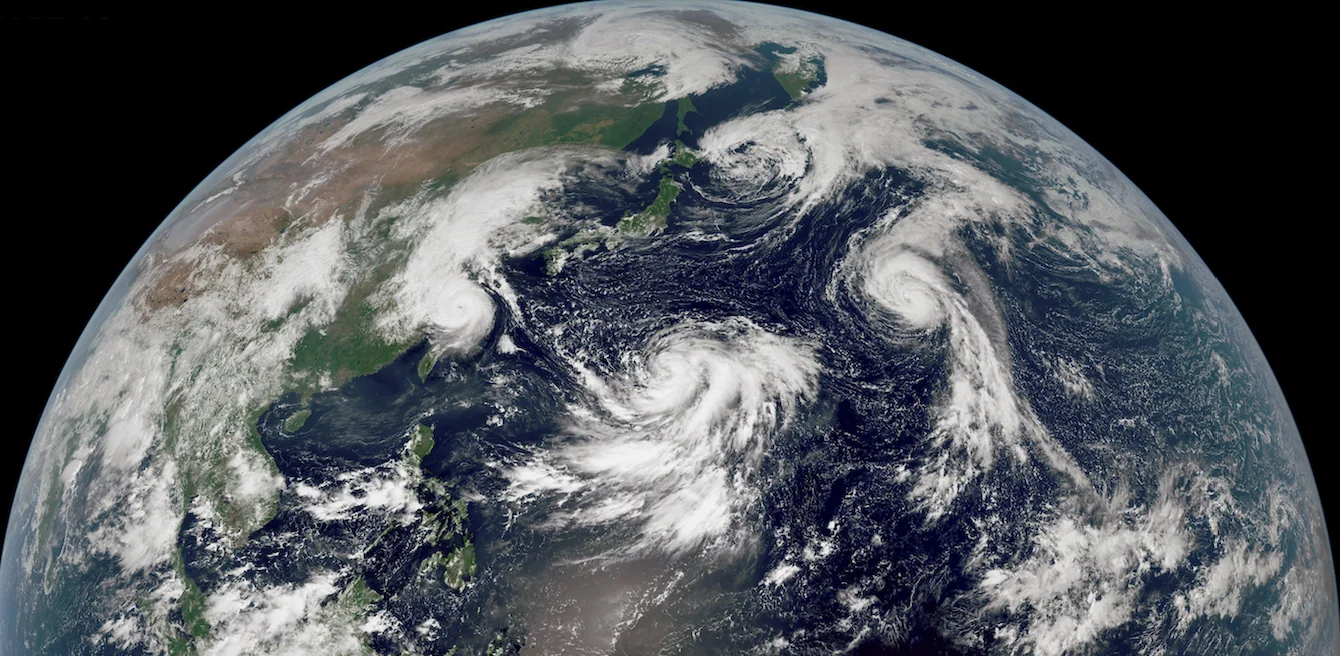
Our work investigates the physical mechanisms, future changes, and probabilistic modeling of multiple tropical cyclone events (MTCEs), focusing on how tropical cyclones cluster in space and time and why these events vary across ocean basins.
Over the western North Pacific, we identify distinct spatial regimes of MTCEs arising from different large-scale circulation configurations, while enhanced midlevel ascent and barotropic energy conversion provide common dynamical support. Variability on quasi-biweekly, intraseasonal, and lower-frequency timescales further regulates their occurrence.
Using high-resolution climate-model simulations, we further examine how MTCEs may evolve in a warming climate. Projections reveal contrasting basin-scale responses, with increasing frequency and persistence over the North Atlantic, declining activity over the western North Pacific, and greater uncertainty over the eastern North Pacific. These changes are linked to shifts in the large-scale environments supporting tropical cyclone genesis, particularly vertical motion and vertical wind shear.
We also develop a probabilistic framework to distinguish dynamically organized clusters from tropical cyclones that simply occur together by chance. Applied to observations and climate simulations, the framework reveals a pronounced shift in MTCE hotspots from the western North Pacific toward the North Atlantic, driven by changes in tropical cyclone frequency and synoptic-scale wave activity, with a tenfold increase in cluster likelihood over the North Atlantic during the past several decades.